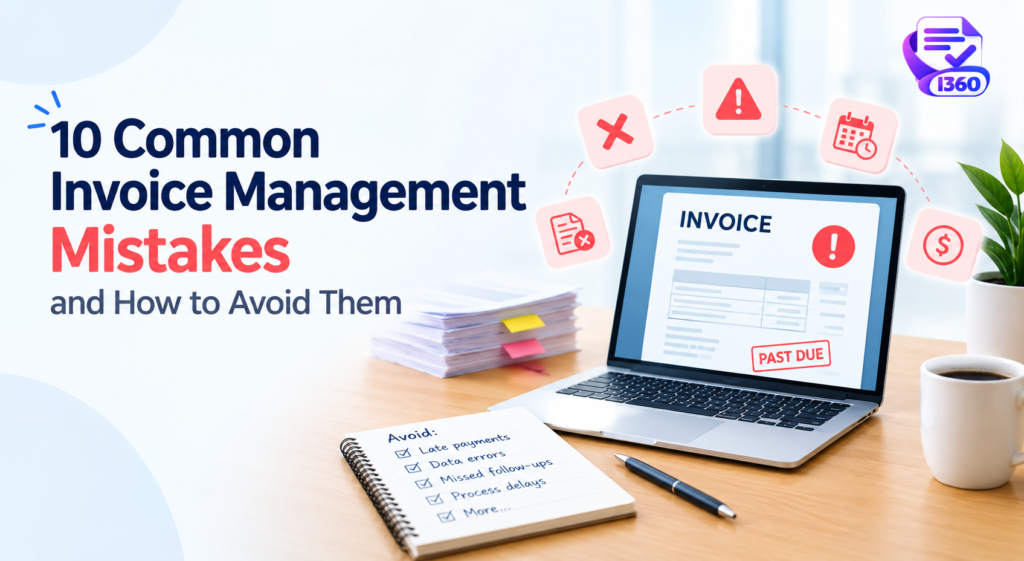
For your successfully running business invoice management is the most important part. But also it is the one of the area where mistake happen frequently From incorrect invoice details and delayed payments to poor record-keeping and tax compliance issues, even small errors can create bigger financial problems over time.
Many businesses depend on manual processes, spreadsheets and distributed documents to manage their invoices. These are methods easily work in initially but at the end they become difficult to handle for the business grow missed payments, duplicate invoices calculation errors and compliance challenges can effect cash flow and create unnecessary stress for finance teams.
Our invoicing 360 make a difference your business with the right tools, simplifying their billing process, improve accuracy and carry smart invoicing practices also automation help with tax calculation, documentation and your requirements.
In this blog we will explore top 10 common invoice management mistakes business make and practical way avoid them.
1. Entering Invoice Incorrect Details
This is the one common invoice management mistake is filling wrong information. May be small error in the customer name, billing address, GSTIN. Invoice number, tax rate or payment amount can lead to payment delays and compliance issue.
How to avoid it
- Before generating invoice double check customer and vendor information.
- Use predefine customer and product databases.
- Reduce invoice data entry by automate invoice creation.
- Before sending invoice you need to review tax rate and calculation.
2. Relying Too Much on Manual Invoice Processing
Multiple business are still create manually invoices using spreadsheets or basic accounting tools. Although manual invoicing may look simple. It becomes time consuming when invoice volume increase.
Also this manual process increase the chances of calculation mistakes, missing information snd inconsistent invoice formats.
How to avoid it
- Invoice generation
- Tax calculation
- Invoice numbering
- Payment reminders
- Invoice tracking and reporting
3. Not Sending Invoice on Time
If you are not able to send an invoice then it can directly affect your business cash flow. When business fail to send invoices promptly after delivering products or services, payments are naturally delayed.
For you small and medium businesses payments delay can create difficulties in managing salaries.
How avoid it
- After completing a transaction create invoices immediately.
- Set clear invoicing schedules.
- Automate invoice generation whenever possible.
- Send invoices through email and digital platform.
- Regularly monitor pending invoices.
4. Ignoring Payment Follow up
Sending invoices does not mean customers will pay on time. Many businesses make the mistake of assuming that customers will remember payment deadlines without receiving reminders.
How to avoid it
- Mention payment clear terms and due dates on every invoice.
- Before the payment deadline send reminders
- Follow on overdues invoice professionally
- Maintain a record of payment history
5. Failing to Maintain Proper Invoice Records
Defective saving records create problems, during financial reviews, audits and tax filing. I have seen many businesses keep invoices in emails, spreadsheets, folders and paper files. This spread of records makes it hard to find the document when needed. Defective saving records waste time. Raise the risk of mistakes. Defective saving records also make auditors uneasy.
How to avoid it
- Maintain a digital invoice repository.
- Organize invoices by date, customer, vendor and invoice number.
- Keep both purchase and sales invoice records.
- Back up important financial documents.
- Ensure authorized team members can access the required records.
6. Making Tax and Calculation and Compliance Error
Tax errors can be very expensive, for companies. Incorrect GST calculations, missing tax information wrong HSN/SAC codes and incomplete invoice details can cause problems when reporting and result in fines.
India makes sure that businesses follow GST invoicing rules, einvoicing standards and record-keeping duties.
How to avoid it
- Keep tax rates updated based on the rules that apply.
- Check GSTIN and other important details, on the invoice.
- Use the HSN/SAC codes.
- Keep tax records correct.
- Look at invoices often to make sure they follow the rules.
7. Not Checking for Duplicate Invoices
Duplicate invoices are a problem especially when several employees are responsible for billing or for handling purchases.
For example the same invoice, from a supplier might be added two times into the accounting system causing a payment or wrong expense records.
This can cause money loss and more work to fix the errors.
How to avoid it
- Verify vendor name, invoice number and invoice date each time. Confirming vendor name, invoice number and invoice date prevents mistakes.
- Implement invoice detection. Duplicate invoice detection saves time and money.
- Establish an invoice approval process. A clear invoice approval process helps everyone stay on the page.
- Review payment records, before processing transactions. Reviewing payment records ensures accuracy.
8 Having Weak Invoice Approval Process
Organizations bills travel through multiple departments before payment is made. When there is no approval process invoices can stay pending for days or even weeks.
How to avoid it
- Everyone knows who must approve what.
- You need to set approval limits that match invoice amounts .
- Set approval deadlines
- Use digital approval workflows to save things.
- Saving dit trail of approval so you can track every step.
9. Not Reconciling Invoices with Payments
Another big mistake is not always matching invoices to the payments.
For example a customer might pay part of an invoice but the invoice still looks like it is fully unpaid. Likewise companies might log vendor payments. Fail to match them to the right invoices.
How to avoid it
- Reconcile. Payments on a regular basis.
- Keep track of payments and full payments in separate records.
- Check bank transactions carefully, against the invoice records.
- Look into any transactions that do not match the records.
- Create accounts receivable. Accounts payable reports regularly
10. Choosing the wrong Invoice Management Software
Some businesses choose invoicing software only because invoicing software is cheap or invoicing software has basic billing functions.. As business needs grow the business may notice that invoicing software lacks mandatory capabilities such, as automation, reporting, integrations or compliance support.
How to avoid it
- GST calculation and compliance support.
- Digital invoice storage.
- Payment tracking and reminders.
- Duplicate invoice detection.
- Approval workflows.
- Real-time financial reporting.
FAQ
Q1. What is Invoice Management ?
Invoice management means making, sending, receiving, tracking, checking and keeping invoices. Invoice management helps businesses keep track of payments keep financialrecords cut down on billing mistakes and boost cash flow.
Q2. What are the most common invoice management mistakes ?
The common invoice management mistakes are things like wrong information on the invoice sending bills too late making mistakes when typing in data by hand not reminding people to pay on time sending the same invoice more, than once keeping bad records getting tax amounts wrong and having not strong enough steps to approve the invoices.
Q3. How can businesses improve their invoice management process ?
Businesses can make invoice management better by using the invoice formats every time automating things that happen over and over again keeping digital copies of all invoices making sure everyone knows the steps to approve invoices keeping track of money that has not been paid yet and checking invoices against payment records on a regular basis.
Q4. What is an invoice management system ?
An invoice management system is a tool to manage all invoicing tasks in one place. it can automatically create invoices, monitor of payments manage approvals, store documents and produce reports. An invoice management system keeps everything organized.
Invoice Management